
How to prepare For NECO Chemistry 2026 Questions and Answers (Essay & Objectives OBJ)
How to prepare For NECO Chemistry 2026 Questions and Answers (Essay & Objectives OBJ)
As the 2026 NECO examination period intensifies, students across Nigeria are searching for the most reliable strategies to secure excellent grades for 2026 NECO Chemistry Essay & Objective Questions and Answers. Whether you are aiming for distinctions in the Sciences, Arts, or Commercial subjects, having access to verified resources is the ultimate game-changer.
Welcome to EXAMCAMPUS, your number one partner in academic excellence. We provide authentic and trusted 2026 NECO Chemistry questions and answers, covering Essay, Objective (OBJ), and for all registered subjects.
The National Examination Council (NECO) had scheduled the 2026 NECO Chemistry paper to kick start on Tuesday 14th July 2026.

NECO CHEMISTRY OBJ ANSWERS
01-10: CBADDBACEE
11-20: DDCDBCDAEB
21-30: BEEDADCEED
31-40: BBBCBBCDCE
41-50: DEEAAAEACC
51-60: ACCDEBCCDD
COMPLETED
NECO CHEMISTRY ANSWERS
NUMBER ONE
(1ai)
(i) Dissolution of salt in water – Physical change
(ii) Burning of paper – Chemical change
(iii) Magnetization of iron – Physical change
(iv) Rusting of iron – Chemical change
(1aii)
Mercury is a liquid at room temperatur
(1bi)
I:
Calcium hydroxide, Ca(OH)₂
Ca = 40, O = 16, H = 1
Mr = 40 + 2(16 + 1)
= 40 + 34
= 74
II:
Lead(II) trioxonitrate(V), Pb(NO₃)₂
Pb = 207, N = 14, O = 16
Mr = 207 + 2(14 + 3×16)
= 207 + 2(62)
= 207 + 124
= 331
(1bii)
Isotopy is the existence of atoms of the same element having the same atomic number but different mass numbers.
(1biii)
(i) ₃E and ₁₉F
(ii) Lithium fluoride (LiF)
(1ci)
Charles’ law states that the volume of a fixed mass of gas is directly proportional to its absolute temperature, provided the pressure remains constant.
(1cii)
Given:
V₁ = 15 cm³
P₁ = 7.50 × 10⁴ N/m²
T₁ = 50°C = 323 K
At STP:
P₂ = 1.0 × 10⁵ N/m²
T₂ = 273 K
Using the combined gas law:
P₁V₁/T₁ = P₂V₂/T₂
V₂ = (P₁ × V₁ × T₂) / (P₂ × T₁)
V₂ = (7.50 × 10⁴ × 15 × 273) / (1.0 × 10⁵ × 323)
V₂ = 9.5cm³
∴ Volume of the gas at STP = 9.5 cm³
(1di)
(PICK ANY TWO)
(i) Diffusion
(ii) Brownian motion
(iii) Expansion of gases on heating
(iv) Gas pressure due to continuous molecular collisions
(v) Compression of gases
(vi) Effusion of gases through a tiny hole
(vii) Random (continuous) motion of gas molecules
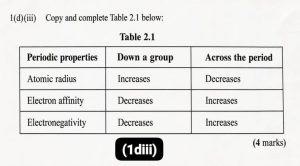
(1dii)
Ionisation energy is the minimum amount of energy required to remove one electron from one mole of gaseous atoms to form one mole of gaseous positive ions.
(1diii)
Check the image below
NECO CHEMISTRY ANSWERS
NUMBER TWO
(2ai)
(PICK ANY TWO)
(i) Haematite (Fe₂O₃)
(ii) Magnetite (Fe₃O₄)
(iii) Limonite (Fe₂O₃·3H₂O)
(iv) Siderite (FeCO₃)
(v) Goethite (FeO(OH))
(2aii)
(PICK ANY THREE)
(i) Environmental pollution.
(ii) Air pollution.
(iii) Water pollution.
(iv) Soil contamination.
(v) Skin irritation and burns.
(vi) Poisoning.
(vii) Respiratory diseases.
(viii) Death when improperly handled.
(ix) Damage to plants and animals.
(2bi)
Li > Na > K
(2bii)
(i) Electrons occupy the lowest energy level first (Aufbau principle).
(ii) The maximum number of electrons in a shell is 2n².
(iii) Orbitals are singly occupied before pairing (Hund’s rule).
(2ci)
Oxidizing agent Accepts electrons and causes oxidation. While Reducing agent Donates electrons and causes reduction.
(2cii)
(i) KOH → K⁺ + OH⁻
(ii) Pb(NO₃)₂ → Pb²⁺ + 2NO₃⁻
(iii) Na₂CO₃ → 2Na⁺ + CO₃²⁻
(2di)
(i) Anode: The anode is the electrode at which oxidation takes place, that is, where electrons are lost by ions or atoms during electrolysis.
(ii) Cathode: The cathode is the electrode at which reduction takes place, that is, where electrons are gained by ions during electrolysis.
(2dii)
Given:
I = 1.0 A
t = 15 min = 900 s
F = 96,500 C mol⁻¹
Molar volume at STP = 22.4 dm³
Q = It = 1.0 × 900 = 900 C
Moles of electrons = 900 / 96,500 = 0.00933 mol
2e⁻ produce 1 mole of H₂
Moles of H₂ = 0.00933 / 2 = 0.00466 mol
Volume of H₂ = 0.00466 × 22.4 = 0.104 dm³
Answer = 0.104 dm³
NECO CHEMISTRY ANSWERS
NUMBER THREE
(3a)
Check the diagram below
(3bi)
(PICK ANY ONE)
(i) Endothermic reaction absorbs heat from the surroundings while Exothermic reaction releases heat to the surroundings.
(ii) Endothermic reaction has a positive enthalpy change (ΔH > 0) while Exothermic reaction has a negative enthalpy change (ΔH < 0).
(iii) Endothermic reaction makes the surroundings colder while Exothermic reaction makes the surroundings warmer.
(iv) Endothermic reaction requires a continuous supply of energy while Exothermic reaction gives out energy after it starts.
(v) Endothermic reaction has products with higher energy than the reactants while Exothermic reaction has products with lower energy than the reactants.
(vi) Endothermic reaction stores energy in the products while Exothermic reaction releases energy to the surroundings.
(vii) Endothermic reaction is represented by a positive heat change while Exothermic reaction is represented by a negative heat change.
(3bii)
Le Chatelier’s principle states that when a system at equilibrium is disturbed by a change in concentration, temperature, or pressure, the equilibrium shifts in a direction that opposes the change and establishes a new equilibrium.
(3biii)
(PICK ANY THREE)
(i) Change in concentration of reactants or products.
(ii) Change in temperature.
(iii) Change in pressure.
(iv) Change in volume (for gaseous systems).
(v) Addition of a catalyst (speeds attainment of equilibrium but does not change the equilibrium position).
(vi) Removal of a reactant.
(vii) Removal of a product.
(viii) Presence of an inert gas (may affect gaseous equilibria under constant pressure).
(3ci)
(i) Saturated solution: A saturated solution is a solution that contains the maximum amount of solute that can dissolve in a given amount of solvent at a particular temperature.
(ii) Molar solution: A molar solution is a solution containing one mole of solute dissolved in one cubic decimetre (1 dm³ or 1 litre) of solution.
(3cii)
Given:
Volume = 250 cm³ = 0.250 dm³
Concentration = 0.2 mol dm⁻³
Molar mass of Na₂CO₃
= (2 × 23) + 12 + (3 × 16)
= 46 + 12 + 48
= 106 g mol⁻¹
Number of moles
= C × V
= 0.2 × 0.250
= 0.05 mol
Mass
= Number of moles × Molar mass
= 0.05 × 106
= 5.3 g
∴ Mass of sodium trioxocarbonate (IV) required = 5.3 g.
(3di)
(i) Paper chromatography
(ii) 4 components
(iii) Chromatography paper (filter paper).
(iv) is the IV part
(3dii)
I: Filtration
II: Crystallization
NECO CHEMISTRY ANSWERS
NUMBER FOUR
(4ai)
A buffer solution is a solution that resists changes in pH when small amounts of acid or alkali are added or when it is diluted.
(4aii)
(PICK ANY TWO)
(i) It is used to maintain a constant pH in chemical reactions.
(ii) It is used in pharmaceutical preparations.
(iii) It is used in medical and clinical laboratories.
(iv) It is used in biological processes and enzyme reactions.
(v) It is used in the calibration of pH meters.
(vi) It is used in analytical chemistry during titrations.
(vii) It is used in the manufacture of cosmetics and food products to maintain a stable pH.
(4bi)
Haber process
(4bii)
(PICK ANY TWO)
(i) It is a colourless gas.
(ii) It is odourless.
(iii) It is tasteless.
(iv) It is slightly soluble (almost insoluble) in water.
(v) It is less dense than air.
(vi) It is a diatomic gas (N₂).
(vii) It has a low boiling point.
(4biii)
(i) Diamond
(ii) Graphite
(4biv)
(i) Diamond: Giant three-dimensional tetrahedral covalent structure.
(ii) Graphite: Giant layered hexagonal covalent structure.
(4bv)
(PICK ANY ONE)
(i) It is used as a fuel.
(ii) It is used for water purification.
(iii) It is used in gas masks to absorb poisonous gases.
(iv) It is used as a decolourising agent in the sugar industry.
(v) It is used for removing bad odours.
(vi) It is used in the manufacture of gunpowder.
(4ci)
I: Alkenes: CₙH₂ₙ
II: Alkynes: CₙH₂ₙ₋₂
(4cii)
(i) CH₃–CH₂–CH₂–CH₃
(ii) CH₃–CH(CH₃)–CH₃
(4ciii)
(i) Butane
(ii) 2-Methylpropane
(4civ)
Given:
Carbon = 60%
Hydrogen = 13.3%
Oxygen = 20.7%
Molar mass = 60
Number of moles:
C = 66/12 = 5.5
H = 13.3/1 = 13.3
O = 20.7/16 = 1.29
Divide by the smallest (1.29):
C = 5.5/1.29 ≈ 4
H = 13.3/1.29 ≈ 10
O = 1.29/1.29 = 1
Empirical formula = C₄H₁₀O
Empirical formula mass = (4 × 12) + (10 × 1) + 16
= 48 + 10 + 16
= 74
∴ the molecular formula is C₄H₁₀O.
NECO CHEMISTRY ANSWERS
NUMBER FIVE
(5ai)
Octane rating is the measure of the ability of petrol (gasoline) to resist knocking or premature ignition in an internal combustion engine.
(5aii)
(PICK ANY TWO)
(i) Cracking breaks large hydrocarbon molecules into smaller molecules, while reforming rearranges the structure of hydrocarbon molecules without reducing the number of carbon atoms.
(ii) Cracking produces alkanes and alkenes, while reforming produces branched-chain, cyclic or aromatic hydrocarbons.
(iii) Cracking increases the quantity of petrol, while reforming improves the quality (octane rating) of petrol.
(iv) Cracking reduces the molecular size of hydrocarbons, while reforming changes only the molecular structure.
(v) Cracking mainly produces unsaturated hydrocarbons, while reforming mainly produces branched-chain and aromatic hydrocarbons.
(vi) Cracking is used to convert heavy petroleum fractions into lighter fractions, while reforming is used to convert straight-chain hydrocarbons into branched-chain hydrocarbons.
(vii) Cracking aims to increase the yield of useful fuels, while reforming aims to improve fuel performance by increasing its octane number.
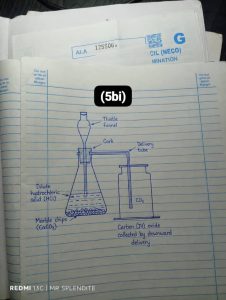
(5bi)
Draw the diagram
(5bii)
CaCO₃(s) + 2HCl(aq) → CaCl₂(aq) + CO₂(g) + H₂O(l)
(5biii)
(PICK ANY TWO)
(i) It is used in fire extinguishers.
(ii) It is used in the manufacture of carbonated (soft) drinks.
(iii) It is used by green plants during photosynthesis.
(iv) It is used as a refrigerant in the form of dry ice.
(v) It is used in greenhouses to promote plant growth.
(5ci)
Vulcanization is the process of heating natural rubber with sulphur to improve its strength, elasticity and durability.
(5cii)
I: Natural rubber
(PICK ANY ONE)
(i) Latex
(ii) Smoked sheet rubber
(iii) Crepe rubber
(iv) Ribbed smoked sheet (RSS) rubber
(v) Pale crepe rubber
(vi) Technically Specified Natural Rubber
II: Synthetic rubber
(PICK ANY ONE)
(i) Neoprene
(ii) Buna-S (Styrene-Butadiene Rubber, SBR)
(iii) Buna-N (Nitrile Rubber, NBR)
(iv) Butyl rubber (IIR)
(v) Silicone rubber
(vi) Thiokol (Polysulphide rubber)
(5ciii)
Given:
Solubility of NaCl at 100°C = 39.8g per 100g of water
Solubility of NaCl at 15°C = 35.9
g per 100 g of water
Mass of water = 80g
At 100°C:
39.8/100 × 80 = 31.84g
At 15°C:
35.9/100 × 80 = 28.72 g
Mass of NaCl precipitated
= 31.84 − 28.72
= 3.12 g
∴ Mass of sodium chloride precipitated = 3.12 g.
NECO Chemistry 2026: Exam Structure, Marking Scheme, Grading System and Areas of Concentration
Preparing for the 2026 NECO Chemistry examination requires more than reading your textbook from cover to cover. Candidates who understand the exam structure, grading system, marking scheme, and the major topics emphasized in the syllabus are better positioned to earn excellent grades.
This guide explains everything you need to know before sitting for the examination.
NECO Chemistry 2026 Exam Structure
The NECO Chemistry examination is divided into three (3) papers for school candidates.
- NECO Chemistry Practical Questions and Answers 2026
- NECO Chemistry Essay/Theory 2026 Questions and Answers
- NECO Chemistry 2026 Objectives (OBJ)
| Paper | Description | Duration | Marks |
|---|---|---|---|
| Paper I | NECO Chemistry Objective (Multiple Choice) | 1 Hour | 50 |
| Paper II | NECO Chemistry Essay/Theory | 1 Hour 30 Minutes | 50 |
| Paper III | NECO Chemistry Practical | Usually 2 Hours 30 Minutes | 50 |
Note: School candidates write all three papers, while private candidates may take an approved practical alternative where applicable. The examination assesses theoretical knowledge, calculations, and laboratory skills.
NECO Chemistry 2026 Marking Scheme
NECO awards marks across the different components of the examination.
| Component | Marks Awarded |
|---|---|
| Objective (Paper I) | 50 |
| Essay/Theory (Paper II) | 50 |
| Practical (Paper III) | 50 |
How Examiners Award Marks
- Correct calculations earn method marks even if the final answer is incorrect.
- Chemical equations should be properly balanced.
- SI units must be used where required.
- Diagrams should be neat and correctly labelled.
- Practical observations must be recorded accurately.
- Candidates should always show complete working in calculation questions.
NECO Chemistry 2026 Grading System
After all papers have been marked, NECO combines candidates’ performance to determine the final grade.
| Grade | Meaning |
|---|---|
| A1 | Excellent |
| B2 | Very Good |
| B3 | Good |
| C4 | Credit |
| C5 | Credit |
| C6 | Credit |
| D7 | Pass |
| E8 | Pass |
| F9 | Fail |
A minimum of C6 is generally regarded as the credit pass accepted by most tertiary institutions for admission requirements.
NECO Chemistry 2026 Areas of Concentration
Candidates should pay particular attention to the following topics during revision.
Atomic Structure
- Atomic models
- Electronic configuration
- Isotopes
- Relative atomic mass
Chemical Bonding
- Ionic bonding
- Covalent bonding
- Metallic bonding
- Hydrogen bonding
- Intermolecular forces
Periodic Table
- Groups and periods
- Periodic trends
- Metallic and non-metallic properties
Mole Concept
- Relative molecular mass (Mr)
- Moles
- Empirical formula
- Molecular formula
- Percentage composition
Gas Laws
- Boyle’s Law
- Charles’ Law
- Ideal Gas Equation
Acids, Bases and Salts
- Properties
- Neutralization
- pH
- Indicators
- Preparation of salts
Organic Chemistry
- Alkanes
- Alkenes
- Alkynes
- Alcohols
- Carboxylic acids
- Esters
- Polymers
Chemical Equilibrium
- Reversible reactions
- Le Chatelier’s Principle
Rates of Reaction
- Factors affecting reaction rates
- Catalysts
Redox Reactions
- Oxidation
- Reduction
- Oxidizing agents
- Reducing agents
Electrolysis
- Electrolytes
- Electrodes
- Faraday’s laws
- Industrial applications
Metals and Their Compounds
- Iron
- Aluminium
- Copper
- Sodium
- Calcium
Non-metals
- Oxygen
- Nitrogen
- Sulphur
- Chlorine
- Carbon
Environmental Chemistry
- Water treatment
- Air pollution
- Greenhouse gases
- Corrosion
Practical Chemistry
- Laboratory apparatus
- Qualitative analysis
- Quantitative analysis
- Titration
- Gas tests
- Flame tests
- Salt analysis
- Laboratory safety
Best Preparation Tips for NECO Chemistry 2026
To improve your chances of scoring an A1:
- Study the official NECO Chemistry syllabus.
- Master chemical calculations and balancing equations.
- Revise practical procedures and laboratory tests.
- Solve past NECO Chemistry questions regularly.
- Focus on frequently tested topics such as Organic Chemistry, Mole Concept, Electrolysis, Chemical Bonding, and Qualitative Analysis.
- Practice time management by attempting full-length mock examinations before the exam.
The 2026 NECO Chemistry examination is designed to assess candidates’ understanding of both theoretical concepts and practical laboratory skills. By studying the areas of concentration, understanding the exam structure and marking scheme, and practising past questions consistently, candidates can approach the examination with confidence and significantly improve their chances of earning an excellent grade.
Conclusion: Achieve Your Academic Dreams
To beat the highly competitive cut-off marks for Nigerian universities and polytechnics, your NECO grades must be top-tier. CAMPUS is here to ensure that your hard work is backed by the right resources. Join thousands of successful students who have utilized our platform to secure their future.
Read Also;
2026 NECO Midnight Expo: Verified Biology Questions and Answers (Essay & Objectives OBJ)
2026 NECO Midnight Expo: Verified Computer Studies Questions and Answers (Essay, Obj & Practical)
2026 NECO Midnight Expo: Verified Further Mathematics Questions and Answers (Essay & Obj)
2026 NECO Midnight Expo: Complete Verified Questions and Answers for English language
2026 NECO Midnight Expo: Verified Mathematics Questions and Answers (Essay & Obj)
JAMB Cut-Off Marks for 2026/2027 Admission Released: (Universities, Polytechnics & Nursing)